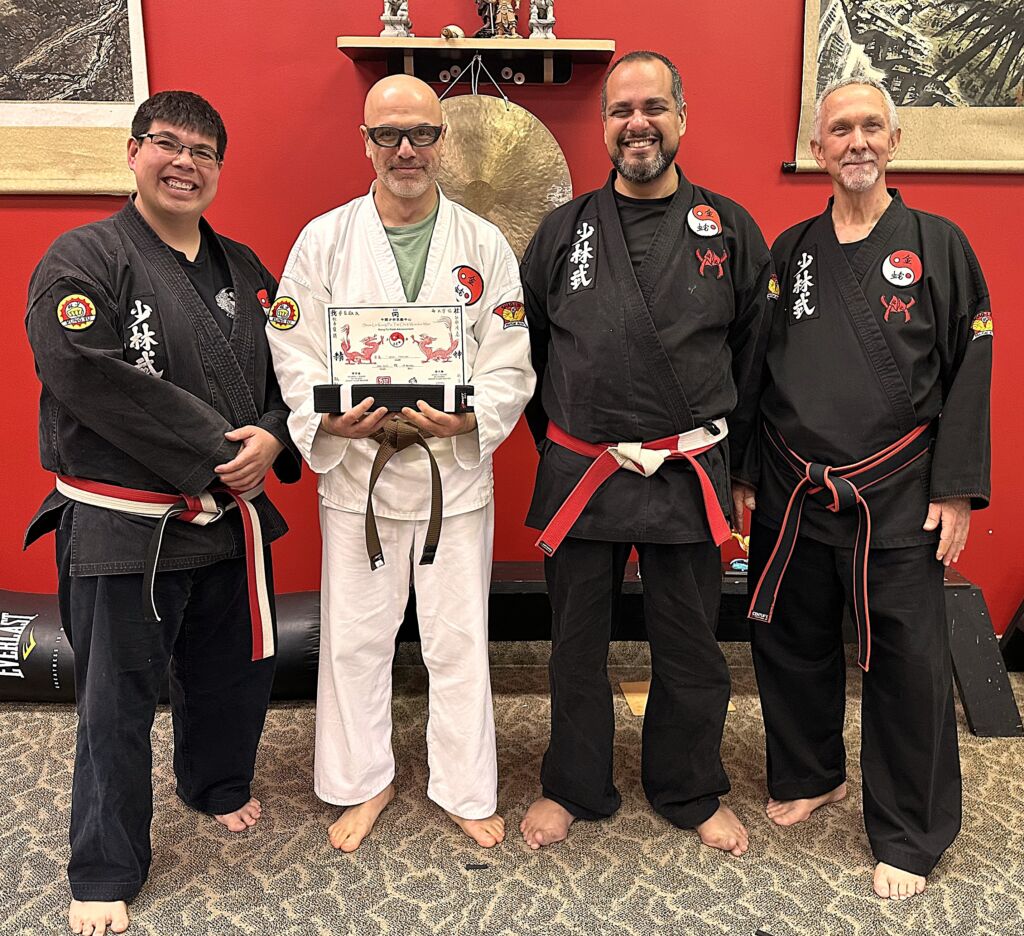
Receiving my black belt. From left to right: Senior Master Christopher Callado, me, Master Mo Sayem (my teacher), and Senior Elder Master David Soard
I was overconfident when I struck my own right elbow with a nunchuck, so hard I thought I had broken it. For six months afterward, my pinkie tingled. When I failed to protect my face from a fast-approaching fist, I ended up with a black eye. I have been kicked in the head, broken my right middle finger trying to block a kick with an open hand, and cracked a rib when I didn’t see another kick coming. And those are only the injuries I can remember.
My fellow students after completing a test in Salt Lake City.
A year and a half ago, at age 49, I decided it was time to study Shao-Lin Kung Fu. I had never been in a fight before. Well, there was the time I was punched in high school, but since I didn’t respond, it hardly qualifies as a fight. Now, at 50, I’m collecting one injury after another. If you’re wondering why someone my age would put himself through this, you’re in good company with my wife.
Sparring makes up only 5 to 10 percent of our training, yet it has had by far the greatest impact on my body. I believe I hold the school record for most injuries, which I admit is a dumb thing to be proud of. Still, these experiences have taught me about conflict: which kinds make me stronger and which are simply too damaging. They have taught me about trust, both in myself and in others. And they have shown me that my body is capable of more healing than I had realized.
I first sparred with a partner when I tested for my yellow belt. He was a 4th degree black belt and far larger than I was. All I remember is running away from him (I do believe he was chasing me). I was so afraid of being hurt that my only instinct was to stay as far from him as possible. That survival mode lasted for months, and I learned almost nothing about defending myself or landing a kick or punch. I equated closeness with pain. There was more risk, and a higher chance of getting hurt. Ironically, once I finally did work up the courage to get close, the serious injuries began. My instincts were too slow and my technique was nonexistent. Worse, it took me a while to figure out which partners I could learn from and which ones were almost guaranteed to hurt me.
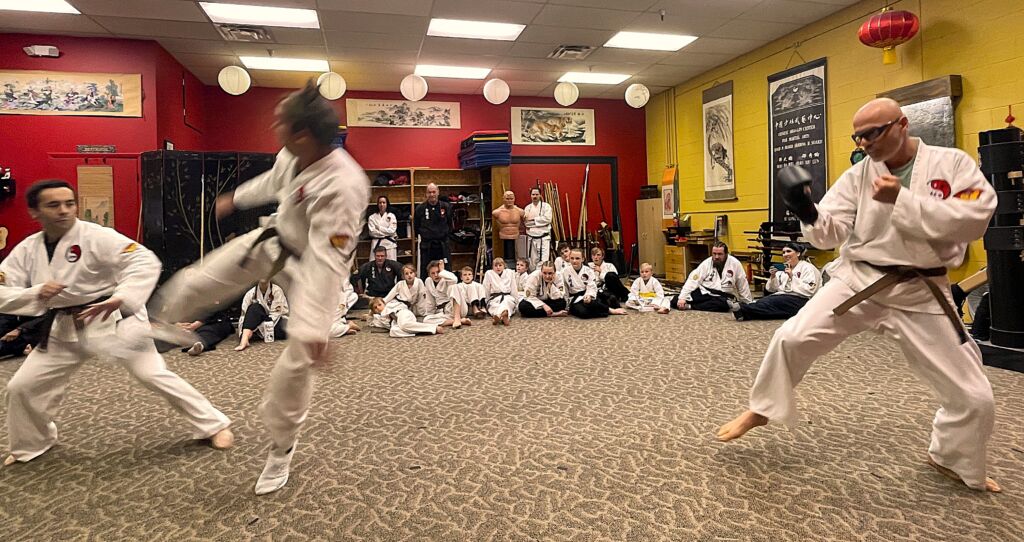
Me on the far right, wearing one sparring glove to protect a broken finger, while practicing what one would call “conflict avoidance.”
For much of my life, I thought of conflict as something purely negative: I would either dominate the other person or be dominated. Either I would land a punch on my sparring partner, or I would end up with an injury that took months to heal. What I am learning now is the power of positive conflict. Some partners can snap a kick with incredible speed or throw a punch with great accuracy, yet when it reaches my body, it feels like a tap. That tap is a signal. It shows me where I went wrong and what to do better next time. It is their physical equivalent of emotional intelligence: recognizing how their actions affect another person and creating a safe environment for others to learn.
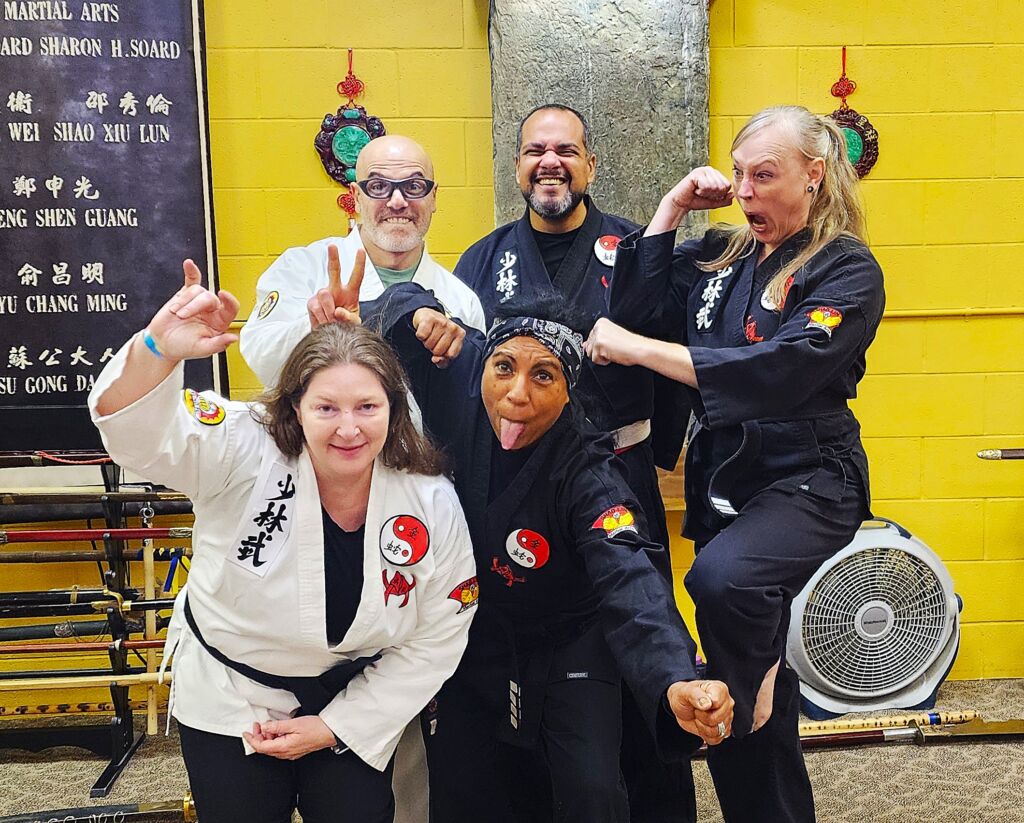
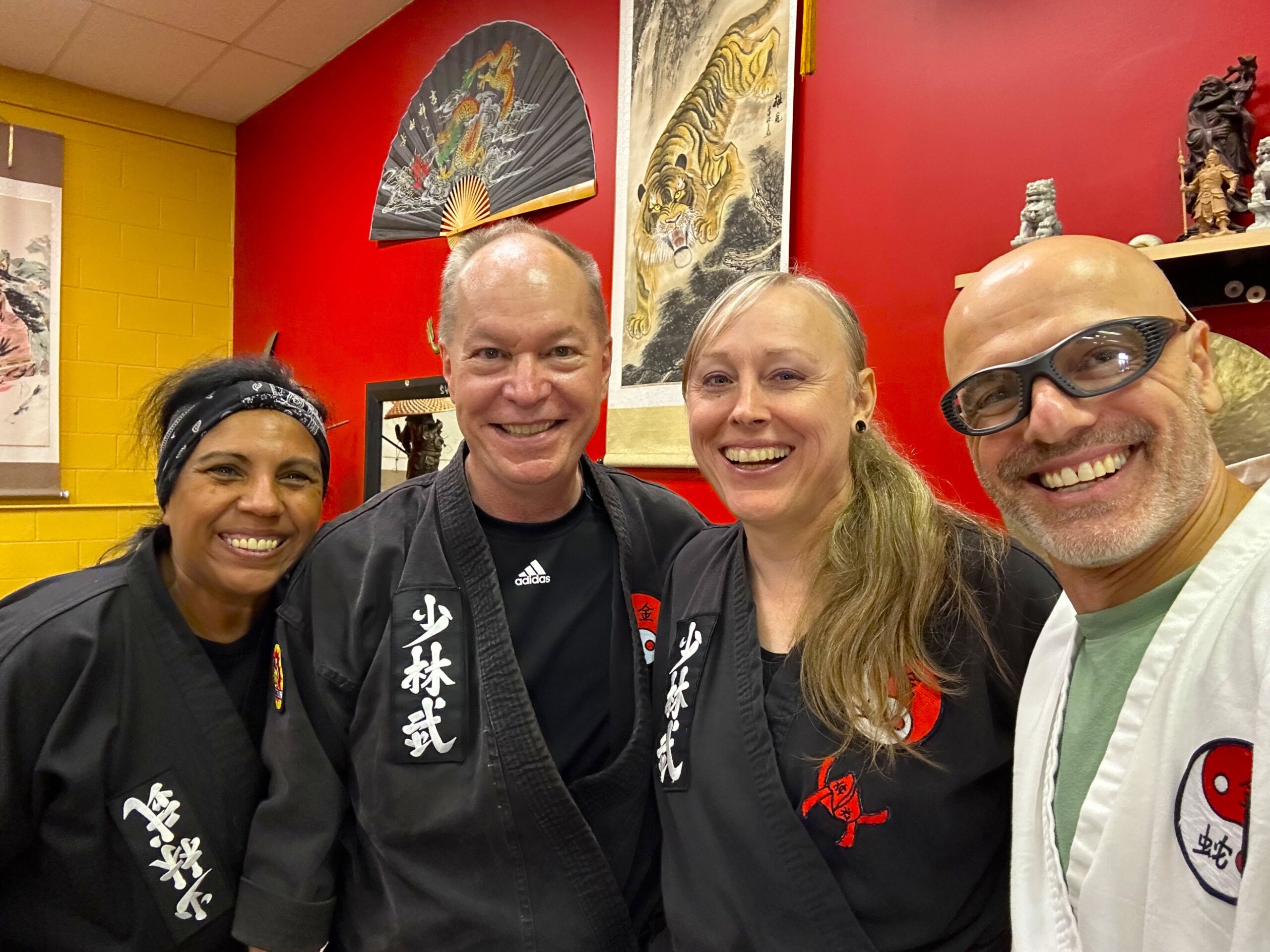
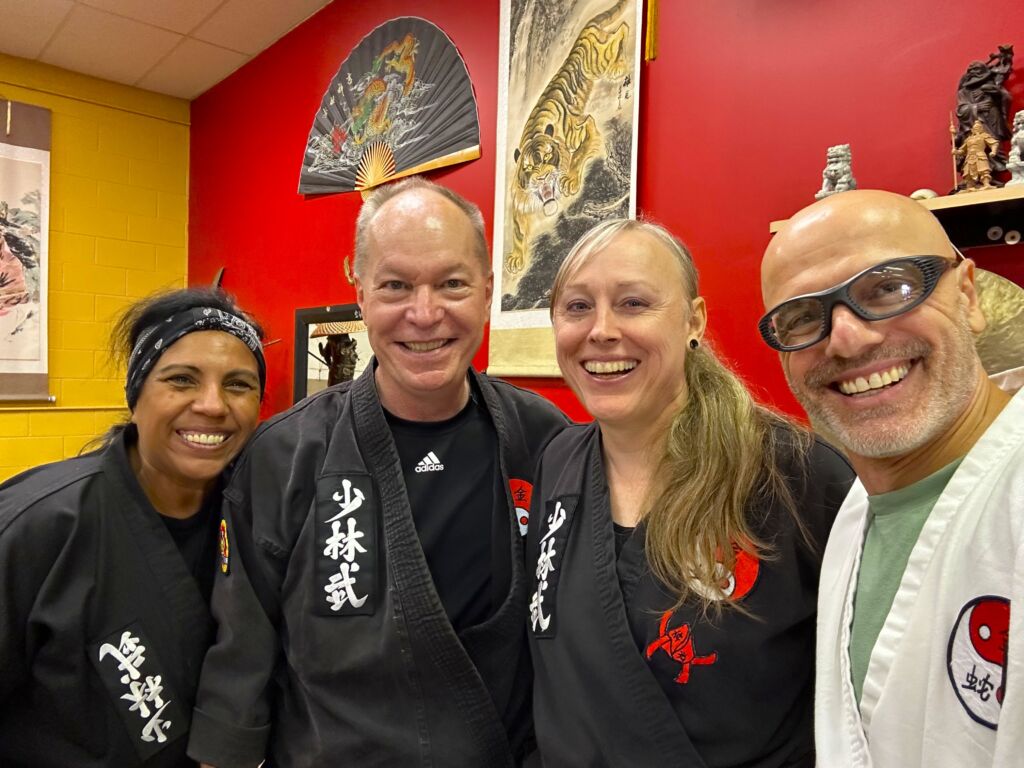
The community I’ve become part of, where we can be our true selves.
I am also learning that to advance, I need to get closer, much closer to my sparring partners. The additional closeness scars me, because it would be so easy to take a blow to the head or a kick to the groin. Still, only through closeness to another person will I learn what I am capable of. Only through closeness will I learn to protect myself, to trust, and to be trusted.
As for why I have kept at this for almost a year and a half: despite the toll on my aging body, I have never felt more alive than when I am in class, surrounded by people who share the goal of bettering themselves. My mind is fully engaged. And my body is teaching me that despite the hurt, and despite the fact that some injuries will never fully heal, I am stronger than I have ever given myself credit for.
Shai Tamari is the Founder & President of Tamari Conflict Management; a Professor of the Practice at UNC-Chapel Hill; and an Adjunct Lecturer at Duke University. He is also a continuing student of Shao-Lin Kung Fu at the Chinese Shao-Lin Center of Raleigh , where he aims to fracture fewer bones moving forward.